
Checking Criminal History in Rhea County
No single portal contains every Rhea County criminal record. Start with the local clerk for a known prosecution, the jail for present custody, and the arresting agency for the event report. TORIS adds a Tennessee repository search, while TDOC FOIL covers felony custody or supervision. Full name, date of birth, a close date range, case or report number, and known name variants help separate people with similar names.
The best order changes with the question. A person checking an old case should begin with the Rhea County Circuit and General Sessions clerk. Someone looking for a recent booking should try the county inmate page, then call the jail if the tool is down or the person has been released. A report request belongs with the officer's agency, not always the sheriff. Follow these steps to keep the search tied to primary records:
- Identify whether the needed record is a court case, police report, booking, statewide history, warrant, or supervision file.
- Give the correct custodian a full name plus the strongest case, report, date, charge, or birth-date detail available.
- Read the result for its scope. An arrest allegation, court disposition, jail status, and TBI entry answer different questions.
- Compare a doubtful match with the originating Rhea County office and ask about copies or correction procedures.
- Order a certified court copy or official TBI product when an informal screen is not enough for personal record review.
Note: A name match alone does not prove that a Rhea County record belongs to the person being researched.
Rhea County Criminal Record Custodians
The place where a record starts controls where it can be found. Rhea County Circuit Court handles felony trials. General Sessions handles misdemeanors, warrants, and early felony work. The sheriff creates county-deputy reports and maintains jail records. Dayton, Spring City, and Graysville police keep their own reports. TBI gathers fingerprint-supported arrest cycles and reported outcomes. TDOC maintains felony offender and supervision data.
The official page describing the Rhea County Justice Center shows why several of these channels now share one campus.
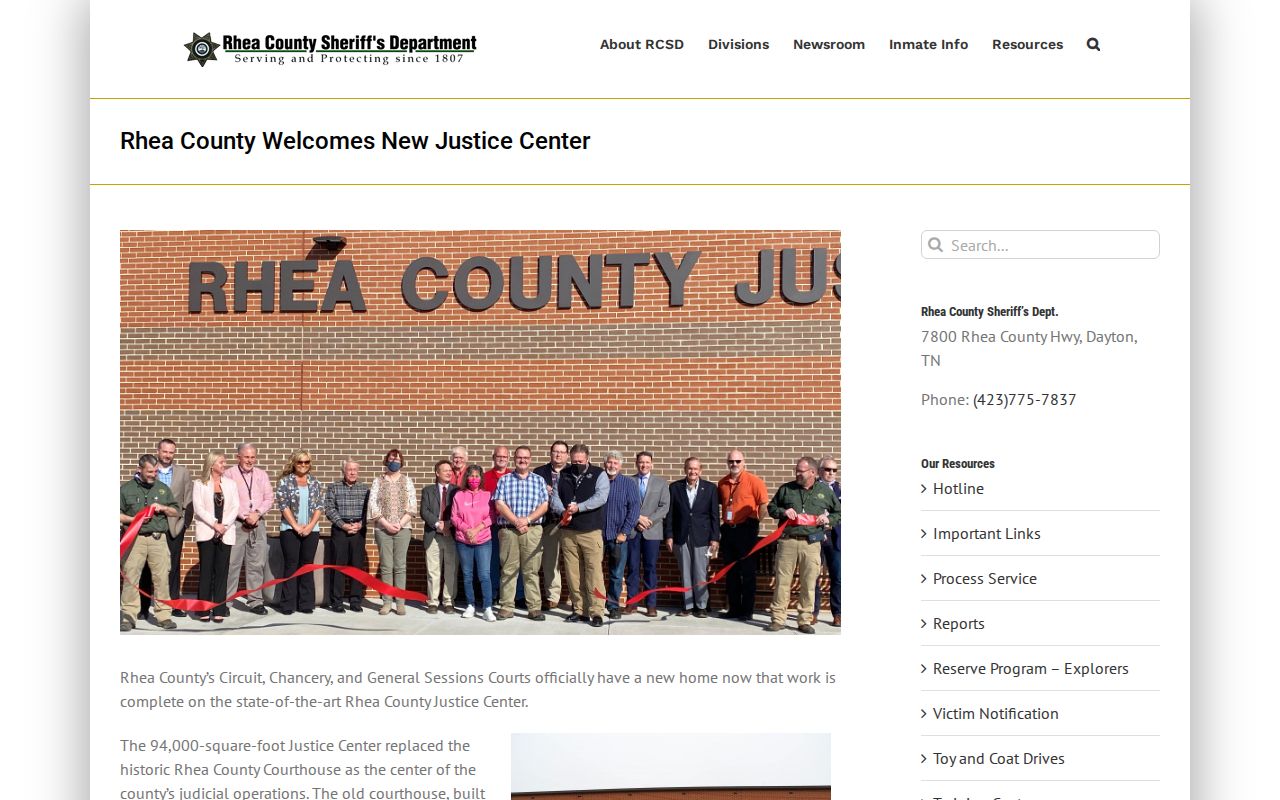
The image connects the modern court, sheriff, and jail setting to the records that each office still keeps as a separate official file.
Record path: officer report → jail booking → clerk case file → reported TBI outcome → TDOC custody or supervision when applicable.
Tennessee Official Background Checks
The Tennessee Bureau of Investigation runs Tennessee Open Records Information Services, also branded TN-FlexCheck. A public TORIS name check costs $29, is nonrefundable, and covers Tennessee repository data. It is not fingerprint-confirmed, and aliases are not used in the initial match. An arrest may be absent when it lacked fingerprint support or a disposition has not reached TBI. A Rhea County court file can therefore contain detail TORIS does not show.
Agency-authorized Tennessee or FBI checks use Tennessee Applicant Processing Services through IdentoGO. The requiring agency supplies the service or OCA code. The person schedules an appointment, presents valid photo identification, and gives fingerprints. Results go to the requesting agency. No fixed Rhea County site was confirmed, so search by a Dayton ZIP and check nearby sites. A person reviewing their own nationwide FBI history may use the FBI electronic record-review process.
The official IdentoGO location and appointment channel illustrates the fingerprint path used when an authorized program requires identity-based results.

That channel is distinct from a public Rhea County name search and should be used only with the code and instructions supplied by the responsible agency.
TORIS Limits for Rhea County Records
TORIS works best as one layer. The online product returns a PDF, and TBI recommends a desktop or laptop. The official BI-0238 paper request supports mail, fax, email, or Nashville counter delivery. It separates subject and requester details and includes two AKA rows, though the initial alias limit still applies. Someone disputing their own result can use TBI's fingerprint-comparison route with law-enforcement fingerprints, a letter, and the published $24 payment.
The official TORIS portal presents the Tennessee name-based search rather than a Rhea County court docket.
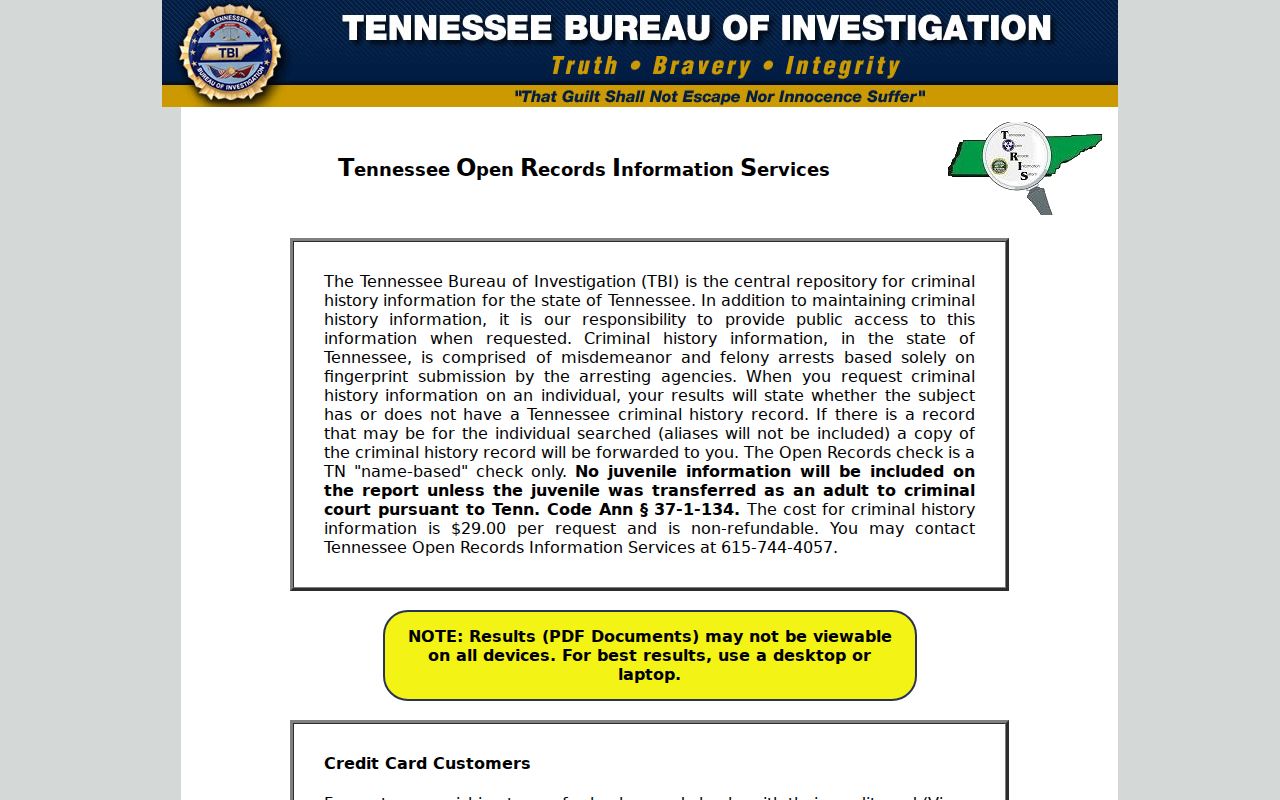
Its fields help identify a possible state record, while a local case number and disposition still must be confirmed with the Rhea County clerk.
| TORIS field | Use | Important limit |
|---|---|---|
| First, middle, and last name | Core name match | Spelling accuracy matters |
| Date of birth | Strong identity detail | A name match is not fingerprint proof |
| Race and sex | Narrows candidates | Does not replace source verification |
| AKA entries on paper form | Supplies alternate names | Aliases are excluded from the initial open-record match |
| Delivery and payment | Selects result route | The $29 fee is nonrefundable |
Criminal Record Types
A criminal record is not one document. In Rhea County, an incident report describes what an officer learned. An arrest report records custody action, while booking data follows intake, property, bond, and release. A complaint or warrant begins a charge. An indictment is the grand jury's filed felony charge. The docket then tracks hearings, pleas, rulings, disposition, and sentence. The first allegation can differ from the final judgment.
State records add other layers. TBI links fingerprint arrests to reported outcomes. TDOC FOIL concerns felony custody and supervision, not fresh county bookings. The Tennessee Sex Offender Registry is separate. Probation and parole information comes from the sentencing court, TDOC, FOIL, and Board materials. Rhea County has no public probation roster. The Rhea County arrest lookup details the divide between arrest, booking, filed charge, and conviction.
Rhea County Justice Center Records
The present address matters. The Rhea County Justice Center is at 7824 Rhea County Highway in Dayton. Opened in 2021 on the former Rhea Medical Center site, the roughly 94,000-square-foot campus placed three courts near the sheriff and a jail designed for 342 people. Space was planned for public defenders, supervision staff, and highway patrol. A secure corridor links jail and court while judges and the public use separate routes.
Downtown's historic courthouse remains tied to the Scopes Trial and old archives, but it is not the current criminal-case counter. Reports over one year old enter archive status. Those over seven years old are kept with historical courthouse archives and take longer to retrieve. Call the clerk before travel because official sources do not publish full parking, locker, recording, or entry rules.
Rhea County Court Clerk
7824 Rhea County Highway
Dayton, TN 37321
423-775-7818
Criminal docket and disposition requests
Sheriff's Department
7800 Rhea County Highway
Dayton, TN 37321
423-775-7837
County reports and jail custody
TDOC Community Supervision
7794 Rhea County Highway
Dayton, TN 37321
423-634-4662
State probation and parole supervision
Inside a Rhea County Criminal Record
Read a Rhea County history as cycles. A state cycle may begin with identity data, an arresting agency, date, fingerprints, and intake charges. A court can later add a different filed charge, dismissal, plea, verdict, sentence, or supervision status. A local file centers on its case number, court, hearings, papers, bond or capias entries, costs, judgment, and disposition. Source and date matter as much as the field label.
Plain terms prevent errors. A disposition is a charge outcome. Nolle prosequi means the prosecutor ended or declined prosecution. A true bill is a grand-jury indictment. A capias commands arrest or appearance. Diversion defers prosecution or judgment under conditions and may support later expungement. None means conviction unless the judgment records guilt.
| Name and identifiers | Name, birth date, and other identity details used to distinguish the subject |
|---|---|
| Arrest and booking | Agency, date, intake charge, booking, bond, custody, and release data when held by that source |
| Filed charge | Offense, Tennessee statute, class, and charging instrument accepted by the court |
| Docket | Chronological court events, hearings, motions, and filed documents |
| Disposition | Dismissal, nolle prosequi, plea, verdict, merger, or other charge outcome |
| Sentence or supervision | Confinement, probation, parole, costs, and related status reported by the proper agency |
Rhea County Jail and Warrant Records
Rhea County's inmate page links to a vendor interface, but the endpoint failed during research. A missing online result does not rule out custody. Call 423-775-7837 when the page is down or release or transfer may explain a no-match. Jail staff create the booking trail, store property, handle trust-fund cash, give the initial court date, and follow bond steps. That record does not establish guilt.
Warrants require another fallback chain. Rhea County publishes no public warrant search. The sheriff's process unit says criminal warrants rest on sworn testimony and are entered in NCIC, which is restricted law-enforcement infrastructure. Check the sheriff, the Circuit or General Sessions clerk, and the right municipal clerk for a city bench warrant. A focused Tennessee Public Records Act request may reach releasable material, but active, sealed, or unexecuted warrant information can be withheld. Anyone resolving their own warrant should confirm the issuing court and case, obtain legal advice when needed, and coordinate the required appearance or surrender.
The sheriff's official warrant and process description shows the local path from sworn grounds to service.
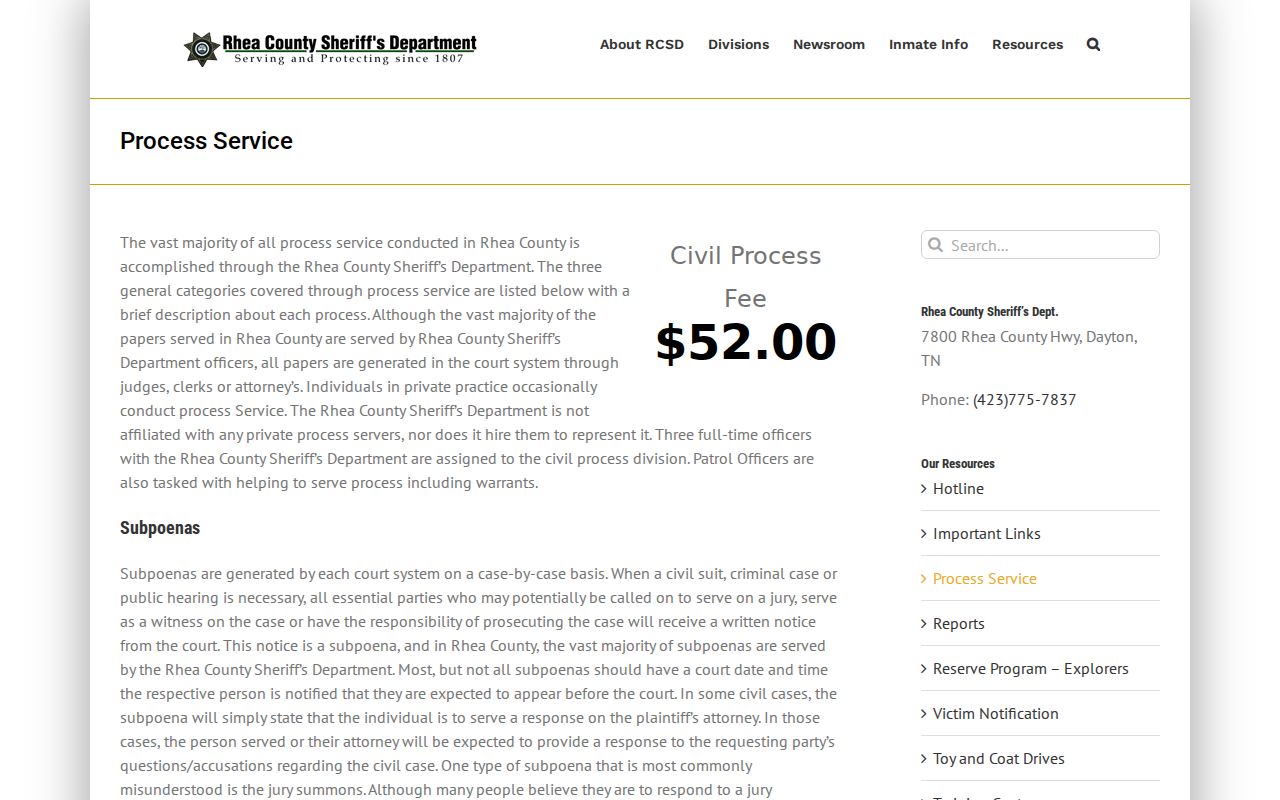
That process explains why an NCIC entry can exist even though residents have no public Rhea County warrant database to search.
Public Access Laws in Tennessee
The Tennessee Public Records Act gives Tennessee citizens access, but not through one portal. Send a request to the office that made or received the record. Identify an existing report by case number, date, place, and type. Inspection is generally free unless law allows a charge, while copies and labor can cost money. If production is not prompt, the agency generally has seven business days to provide, deny with a legal basis, or state the time needed.
Access has limits. Active investigative details, sealed material, juvenile data, protected victim or minor information, Social Security numbers, and judicial work product may be withheld or redacted. Courts also follow Rule 34. One confidential field need not close a whole file if it can be redacted. Ask the Rhea County custodian for a legal explanation when access is denied.
Key Tennessee access rules:
Tenn. Code Ann. § 10-7-503 defines public-record access, citizen status, specificity, and response duties.
Tenn. Code Ann. § 10-7-504 protects listed confidential information and records.
Tenn. Code Ann. § 10-7-505 provides a court remedy for a public-record denial that violates the Act.
Tennessee Supreme Court Rule 34 governs public court records and excluded judicial material.
Tenn. Code Ann. § 40-32-101 guidance explains Tennessee expungement routes and eligible outcomes.
Rhea County Sheriff Report Requests
The Rhea County Sheriff's report process is mainly by phone and at the counter. After an incident, the responding deputy gives the victim a small card with the report label and case number. The deputy writes the report, a supervisor reviews it for errors, and the file then goes to the administrative office. That review explains why a report is not always ready when the officer finishes the first draft. Basic reports are ordinarily available the next day, while complex crashes, serious investigations, and weekend events can take longer.
Two official sheriff pages list different weekday opening times, one at 8 a.m. and one at 9 a.m., though both close at 5 p.m. Call 423-775-7832 or 423-775-7837 before making the trip. Bring the report card if available. Otherwise provide the date and approximate time, officer name, incident place, record type, and case number. Most importantly, the sheriff cannot supply a report written by Dayton, Spring City, or Graysville police. That request must go to the city agency that handled the event.
The sheriff's official general information and report-fee page publishes the local copy prices.
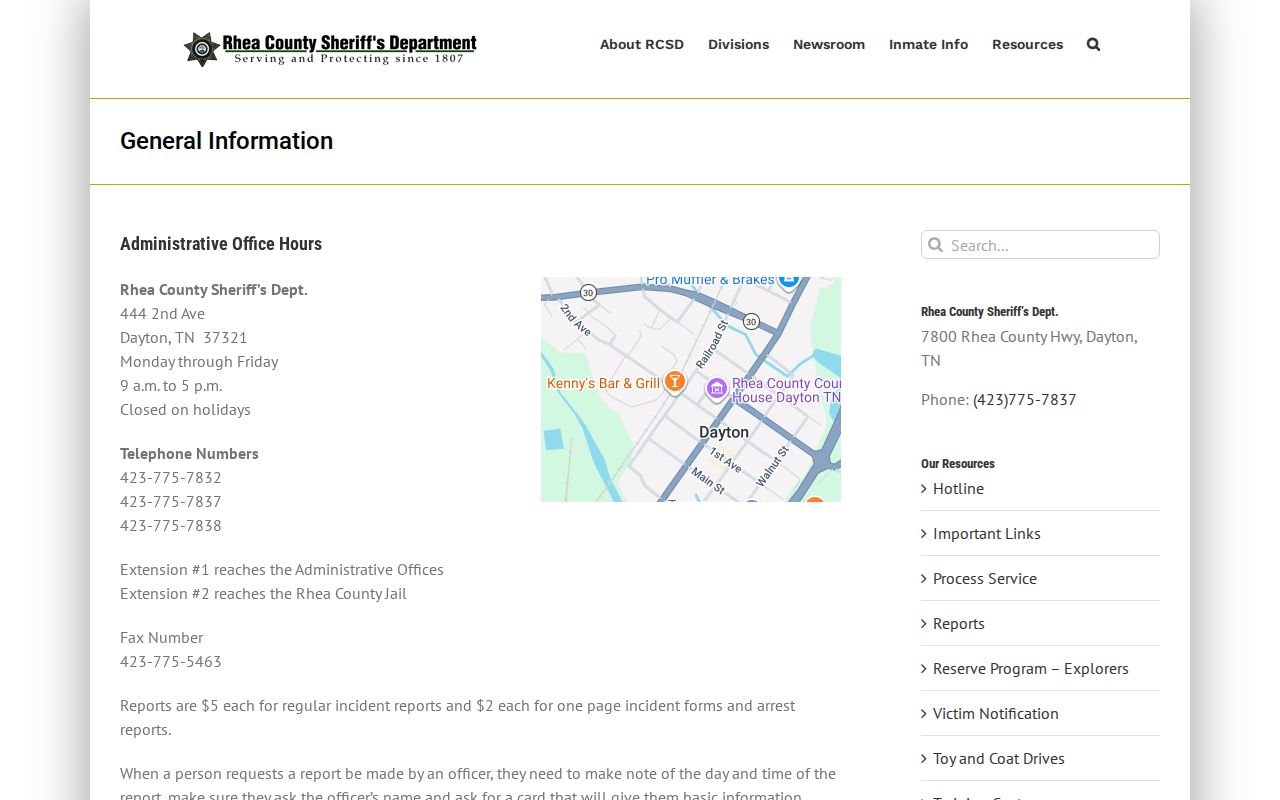
The posted amounts help a requester distinguish a short arrest form from the fuller incident narrative before asking the Rhea County counter for a copy.
| Sheriff record | Published amount | Retrieval note |
|---|---|---|
| Regular incident report | $5 | Fuller incident product |
| One-page incident form | $2 | Short form |
| Arrest report | $2 | Custody action, not a judgment |
| Older than one year | Not published | Archive status |
| Older than seven years | Not published | Historical courthouse archive, longer retrieval |
Sealed, Expunged, and Restricted Records
Tennessee expungement can remove qualifying criminal records, but eligibility depends on the exact charge and outcome. Dismissed charges, no true bills, arrests followed by release without charge, not-guilty verdicts, nolle prosequi outcomes, and certain successfully defended or denied protection orders can qualify for free relief. Begin with the Rhea County court where the case arose. Get the docket number, identify each charge, ask whether each needs a separate form, and request a certified order and charging instrument after relief is granted.
Some convictions also qualify under offense-specific rules. Official guidance includes eligible misdemeanors and Class E felonies, with limited paths for some Class C or D convictions. The usual waiting period is at least five years after completion for qualifying misdemeanors and Class E felonies, and ten years for qualifying Class C or D cases. A low offense class alone never guarantees relief. A retired charge must first become dismissed, and a dismissal with costs requires those costs to be resolved or waived.
Once a judge grants relief, the clerk sends the order to the arresting agency, jail, TDOC, and TBI. TBI removes qualifying charges and related fingerprint-card material, then sends the order into FBI processing. Keep a certified copy. Juvenile information, sealed orders, victim details, protected identifiers, and active investigative files may also have access limits that arise outside expungement.
Rhea County Custody and Supervision Records
County jail, state prison, and community supervision records should not be blended. The Rhea County Jail shows local custody, including people awaiting trial, those unable to make bond, local sentences, and some state-ordered time. TDOC FOIL concerns current and former Tennessee felony offenders and can show incarcerated, probation, parole, or inactive status, location, offense, sentence, hearing, and release data described by the agency. VINELink provides confidential custody notifications. Federal custody belongs to the Bureau of Prisons system and does not appear merely because a person once had a Rhea County case.
The TDOC FOIL page marks the point where a county search moves into Tennessee felony custody or supervision.
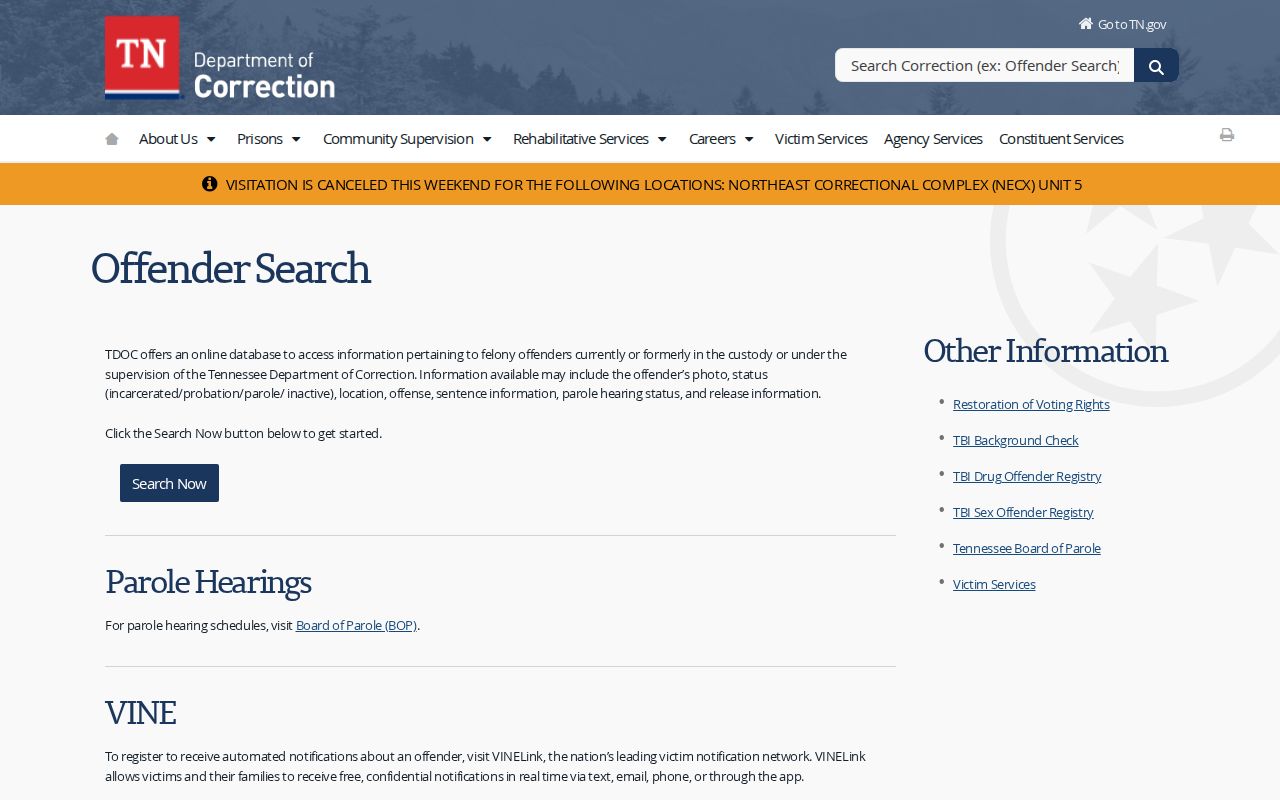
FOIL should not be used as a substitute for a recent Rhea County jail check, since release, transfer, and court status follow separate record systems.
- Probation
- Court-ordered community release under conditions, supervised in Rhea County mainly through TDOC Community Supervision.
- Parole
- Conditional release approved by the Tennessee Board of Parole before the sentence expires, with TDOC supervision.
- Determinate release
- A Tennessee form of special probation for certain short felony sentences after the required share has been served.
- FOIL
- The Tennessee felony offender search, not the Rhea County current-inmate roster.
Rhea County Criminal Records by City
Rhea County has three incorporated municipalities: Dayton, Spring City, and Graysville. Their police departments create and keep their own incident and arrest reports. A city record does not move into the sheriff's report files merely because the city lies in Rhea County. Municipal court records also begin with the city clerk, while a filed county prosecution belongs with General Sessions or Circuit Court and county custody is checked through the jail. The cards below match the official population rank and point to each local access route.
Dayton Criminal Records
Largest city and county seat
Dayton PD and City Court at the municipal complex
Spring City Criminal Records
Second in official population rank
Police station also hosts scheduled traffic court
Graysville Criminal Records
Rhea County's smallest incorporated city
Police and municipal offices share Harrison Avenue
Rhea County Record Oversight and History
Rhea County's records geography spans three eras. The county formed in 1807, the historic Dayton courthouse hosted the 1925 Scopes Trial, and daily justice work moved to the integrated highway campus in 2021. The old courthouse remains a landmark and an archive point, while modern court, jail, and supervision records are routed to their present custodians. That history is more than local color. It explains why an old file, a current case, and a jail record can carry different addresses even when they concern the same person.
Recent oversight also reinforces the need to verify records at their source. In October 2024, the Tennessee Comptroller reported findings from an investigation of sheriff department operations covering January 2017 through May 2024. The findings concerned internal controls and conduct, including releases without required court-officer approval. They should not be treated as proof about uncharged people, but they do show why court authority, jail release data, and agency records must be checked against one another.
The Comptroller's official Rhea County sheriff investigation summary supplies the documented oversight context.
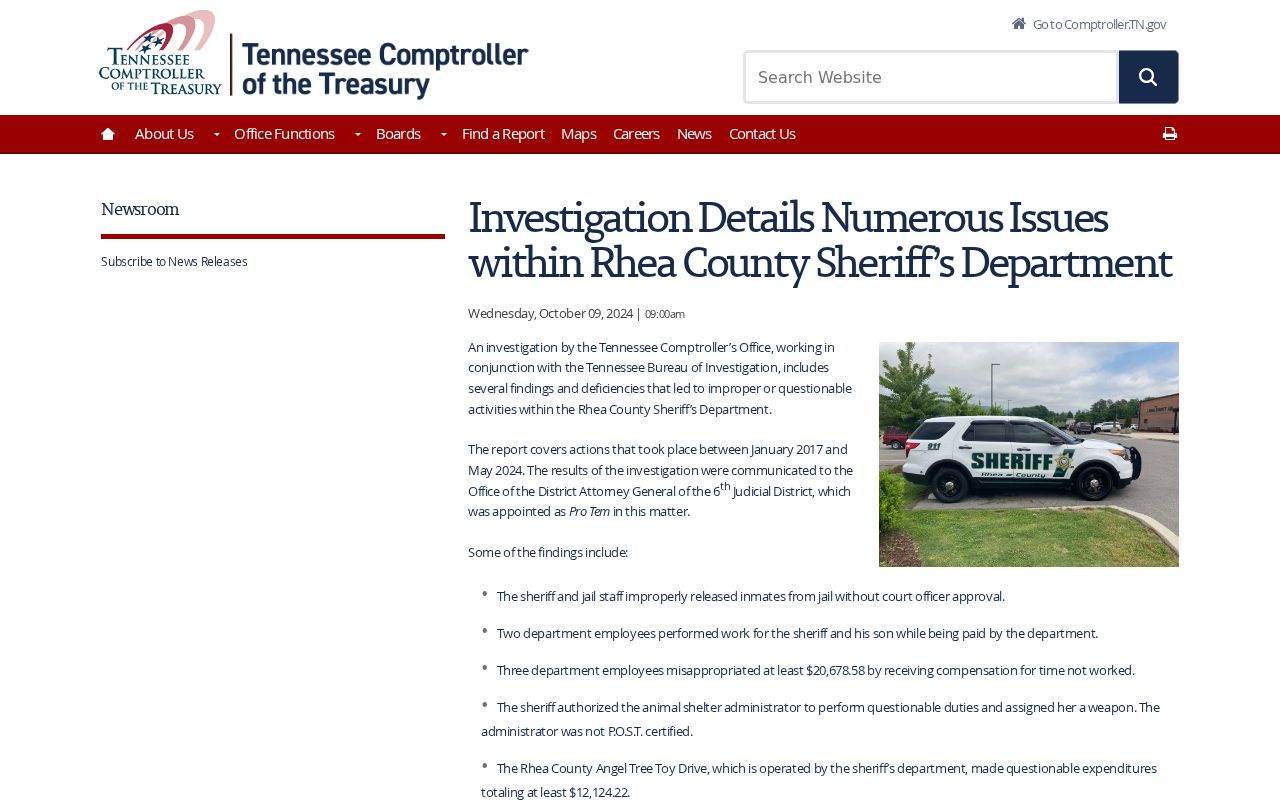
The review underscores a sound records practice: compare a Rhea County jail event with the order, docket, or agency file that officially authorized it.