
Checking Criminal History in Dayton
Start at city level when a Dayton officer handled the event. The police office can address an incident or arrest report, and the City Court clerk can address municipal citations and the court's own file. Neither office is a substitute for the county jail or the Circuit and General Sessions clerk. TBI's TORIS product is another distinct record, built from Tennessee repository data rather than a search of Dayton files.
- Contact Dayton Police at 423-775-8403 or police@daytontn.net and give the event date, place, names, and report number if known.
- Ask for the specific police report. Use Dayton's online open-records form when the direct email route does not resolve a formal request.
- Call Dayton City Court at 423-775-1817 for a municipal citation, payment record, schedule, or docket inquiry.
- Check Rhea County jail custody and the Circuit or General Sessions clerk when the event moved beyond city-level processing.
- Use TBI TORIS only when a Tennessee-wide, name-based repository check serves the need and its limits are understood.
This order keeps Dayton records at city altitude. For a complete county prosecution, the fuller Rhea County criminal court case record belongs with the county clerk.
Emailing Dayton Police Records
Dayton publishes police@daytontn.net for general questions and incident reports. That direct channel matters because the city's broader open-records form does not offer “police report” in its record-type dropdown. A clear email should identify the type of report, the date or narrow date range, the event location, the subject, and any known case number. Those details help staff find an existing record without asking them to create a new summary.
The official Dayton Police Department page shows the department's report contacts and crash-report route.
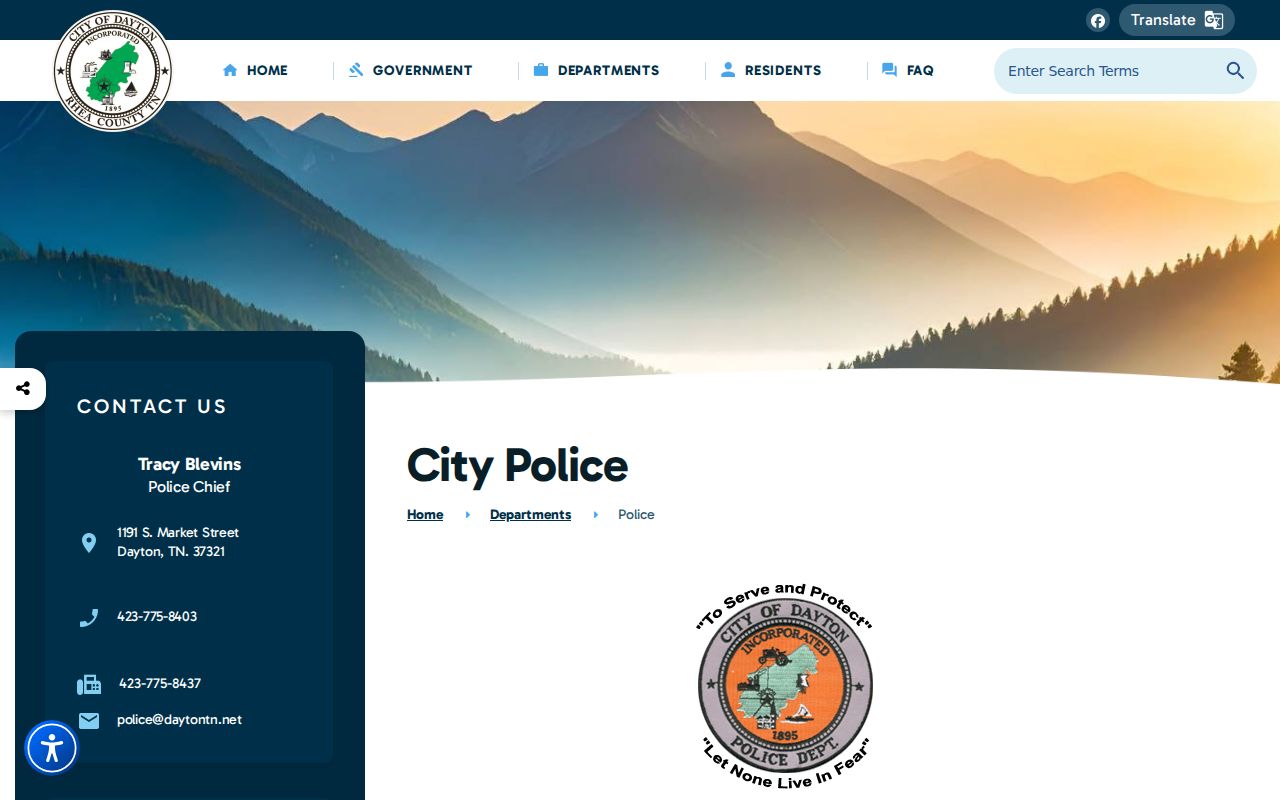
The city page makes the police office, rather than the county sheriff, the first stop for a report created by a Dayton officer. Fax is also published at 423-775-8437, but the research does not establish a separate fax request procedure, fee, or fixed response time. Confirm those details before sending material by fax.
Dayton Police Department Records
Police Chief Tracy Blevins leads the Dayton Police Department. The municipal complex is at 399 1st Avenue, Dayton, Tennessee 37321. The police office number is 423-775-8403, and Central Dispatch is 423-775-3876. City Hall publishes weekday municipal building hours of 8 a.m. to 4:30 p.m. The research does not confirm a separate police-records counter schedule, so a call before a visit is wise.
A Dayton police file may document the officer's observations, reported allegations, people involved, place, and time. It does not establish the final court result. A charge may be changed, dismissed, or replaced later. Dayton also directs crash-report buyers to PurchaseTNCrash about five to seven business days after an accident. That crash channel is separate from a general incident-report email.
Dayton Police Department
399 1st Avenue
Dayton, TN 37321
423-775-8403
police@daytontn.net
Dayton Criminal Record Numbers
TBI's official 2023 NIBRS report gives context for records made by the Dayton agency. It reports an estimated covered population of 7,493, 344 Group A offenses, 209 cleared offenses, and 291 arrests. Of those arrests, 274 were reported as adult and 17 as juvenile. The profile also lists 51 domestic-violence victims and 1.18 offenses per incident.
Those are agency-level NIBRS measures. They are not a list of people, do not prove conduct by any person, and should not be treated as every event in Dayton. “Cleared” is also not the same as a conviction. A clearance can reflect law-enforcement case status, while conviction must be confirmed from a court disposition.
Dayton Arrests and Bookings
A Dayton arrest can create several records at once. Dayton Police keeps the originating incident or arrest report. Rhea County Jail creates the intake, custody, bond, property, and release trail if the person is booked there. A filed prosecution creates a clerk record. Fingerprint-supported arrest data and later reported outcomes may reach the Tennessee Bureau of Investigation under state reporting law.
Dayton does not advertise a city jail. Research supports tracing county custody through the Rhea jail, but it does not publish a formal Dayton transfer contract or exact handoff timetable. Do not infer that a missing current-inmate result means no arrest occurred. Release, transfer, a portal outage, or a delay can explain the absence. The county inmate wrapper has also returned an error during inspection, so 423-775-7837 is the practical jail fallback.
Note: An intake charge describes the booking stage and may differ from the charge later filed or resolved in court.
Dayton Open Records Form
Dayton's web form is the formal fallback when a direct police email is not enough. It asks for the requester's first and last name, address, email, phone, preferred contact method, identification type, and signature. It also allows an optional upload. The request description must state the record type, timeframe, subject or keywords, and enough detail to locate the material.
The official Dayton open-records page shows the full request form and inspection choices.
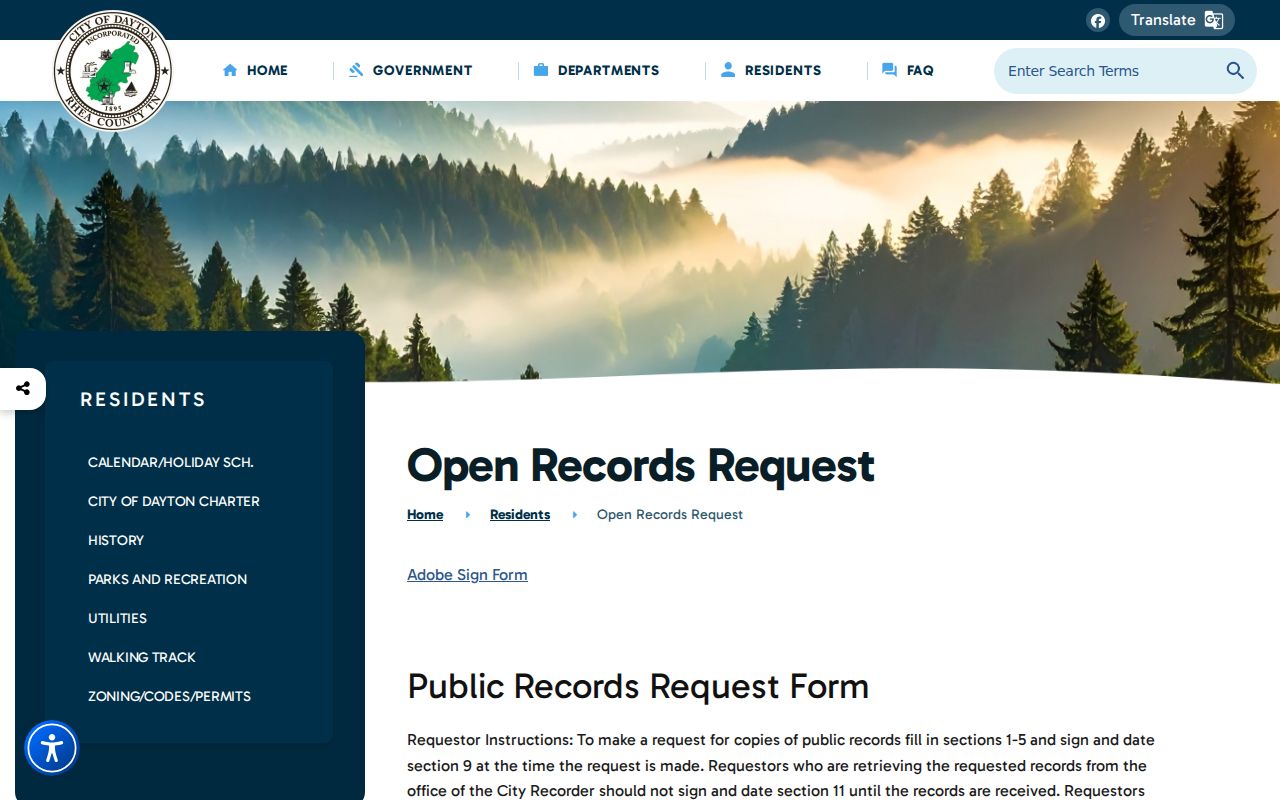
The form distinguishes Inspection/Access from Copy/Duplicate and displays an “Inspection Waved” option using the city's own spelling. Its record dropdown lists items such as minutes, annual reports, financials, budgets, and employee files, but not police reports. Use police email first for incident material, then use the form to make a precise public-records request if needed.
Municipal Court Records in Dayton
Dayton City Court operates at the same 399 1st Avenue municipal address as the city offices. Judge Will Dunn serves the court, and Clerk Brandi R. McSpadden maintains records, answers inquiries, processes payments, and coordinates schedules. The clerk can be reached at 423-775-1817, by fax at 423-775-8404, or at brandimc@daytontn.net.
The official Dayton City Court page identifies the court staff and contact routes.
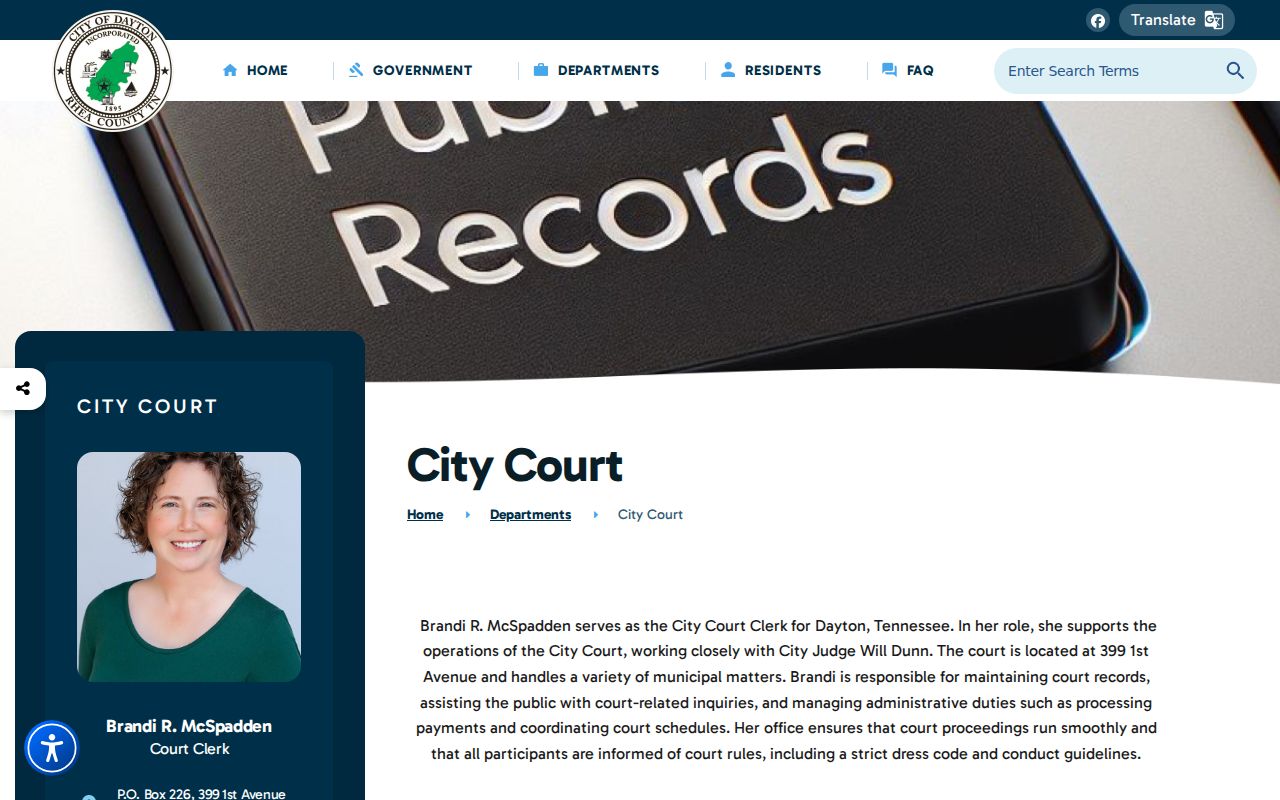
No public online Dayton docket was located. A requester should call or visit the clerk and provide the name, citation or case number, and approximate date. The official page does not support claims about a published fee schedule, online search fields, or guaranteed turnaround.
| Court Name | Dayton City Court |
|---|---|
| Known Custodian | City Court Clerk Brandi R. McSpadden |
| Case Types Heard | Municipal matters reflected in the City Court file; the official source does not publish a complete jurisdiction list |
| Case Lookup Channel | Clerk phone, email, or counter; no public online docket found |
| Record Contents | Citation or case identifiers, schedule, payment, and disposition information when present in the clerk file |
| Copies & Fees | No City Court copy fee was located in the official sources; confirm with the clerk |
Dayton City and County Records
Two court addresses can trip up a Dayton records search. Dayton City Court is at 399 1st Avenue. Rhea County Circuit and General Sessions work is at 7824 Rhea County Highway in the modern Justice Center. The historic courthouse tied to the Scopes Trial is another landmark, but it is not the everyday counter for current county criminal cases.
| Record | Starting office | Why |
|---|---|---|
| Dayton police report | Dayton Police | The city keeps reports made by its officers |
| City Court record | Dayton City Court clerk | The municipal clerk maintains that local file |
| Felony or county misdemeanor case | Rhea Circuit/General Sessions clerk | County courts hold charging and disposition records |
| Current county custody | Rhea County Jail | The jail holds booking and release data |
Ask which court appears on the citation or case document before traveling. City Court cannot supply the full Circuit file, and the county clerk does not replace the Dayton police report.
Where Dayton Records Go
The record trail grows as a Dayton matter moves through the justice system. A city officer creates the first report. A county booking can add intake and custody data. General Sessions may handle an initial felony step or a misdemeanor. An indicted felony proceeds in Circuit Court. Courts then report qualifying activity and dispositions to TBI, where the event may become part of an identity-centered state history.
Record flow: Dayton Police Department › Rhea County Courts › Tennessee Bureau of Investigation
Each stop answers a different question. The Dayton report gives the event narrative. The jail record shows custody. The court file shows filed charges and outcome. TORIS may show a reported Tennessee criminal-history cycle, but its initial name match does not include aliases and is not fingerprint identity confirmation. A no-match in one channel does not erase the others.
Inspecting Dayton Criminal Records
Inspection and copying are separate choices in Dayton. The city says inspection carries no fee unless law permits one, while copies and labor can be charged under the governing policy. Dayton also bars personal phones, cameras, and scanners in the inspection room. A visitor expecting to photograph pages may therefore need to request copies instead.
The Tennessee Public Records Act lets Tennessee citizens inspect public records unless a law makes them confidential. A city may redact protected identifiers, juvenile information, victim details, or active investigative material. When records cannot be produced promptly, the custodian generally has seven business days to produce them, deny the request with a legal basis, or explain the time needed.
A narrow request works best. Ask for an existing report by date, place, case number, and record type. Do not ask staff to build a new narrative or compile facts that are not already kept as a record.
Dayton Criminal Records Landmarks
Dayton is Rhea County's seat and largest city. Its records geography reflects that role. Municipal police and court work stay at the First Avenue complex, while county criminal court and jail work use the highway Justice Center. The historic courthouse marks the 1925 Scopes Trial and remains central to Dayton's legal identity, yet current records users must distinguish a landmark from an active records counter.
The official City of Dayton page presents the municipal building and city services.
The civic image reinforces the city-level starting point. A police report or municipal court inquiry begins with Dayton. A county criminal case or jail booking does not. That physical split is one of the most useful facts in a local Dayton criminal history search.
Public Access Rules in Dayton
Dayton police and municipal records are subject to Tennessee access law, but public does not mean unrestricted. Tennessee citizens may request existing records with enough detail for staff to locate them. Confidential statutes, active investigations, protected personal data, sealed material, and juvenile or victim information can limit release. Court records also follow Tennessee Supreme Court Rule 34.
Key Statutes:
Tennessee Public Records Act, Tenn. Code Ann. §§ 10-7-503 through 10-7-506 gives Tennessee citizens access to public records, subject to exemptions, identification rules, and lawful copy charges.
Tennessee Supreme Court Rule 34 governs court-record access and excludes sealed, confidential, judicial-work-product, and internal case-management material.
Ask the custodian to identify the basis for any denial or redaction. For a correction to a state criminal-history result, the proper route is TBI's dispute process, not a request that Dayton alter a court or repository record it does not control.